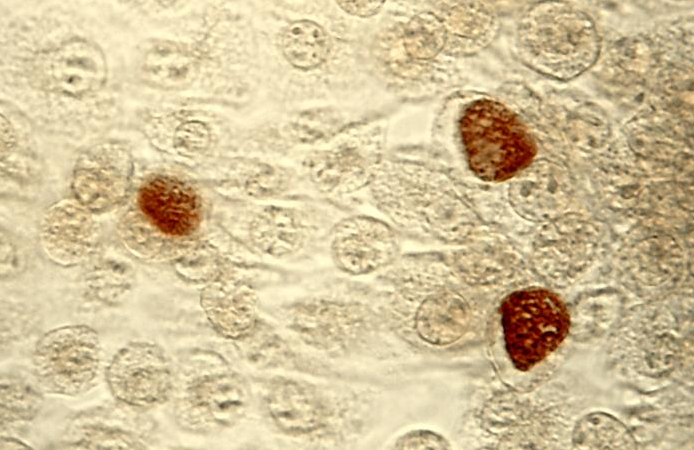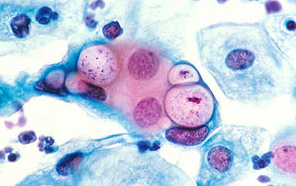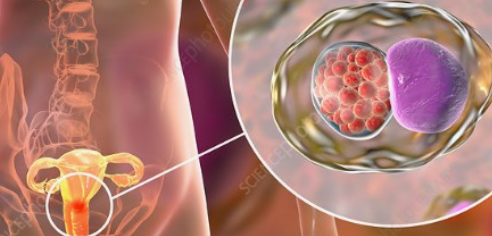
Persistent InfectionClinical significance.It seems likely that all chlamydial species are capable of causing persistent infection. Cases of Chlamydophila pneumoniae infection of the human respiratory tract are documented from which it was possible to recover viable chlamydiae on multiple occasions for up to 11 months despite standard treatment with tetracyclines [Hammerschlag et al., 1992]. The fact that this organism is associated with a diverse range of infections suggests that the common, underlying, factor must be the ability of C. pneumoniae to persist for years at the site concerned, in the absence of effective treatment. C. psittaci has long been known to cause chronic, often asymptomatic infections in animals, particularly psittacine Persistent infection in trachoma.Trachoma is a chronic ocular infection with C. trachomatis which tends to occur in poor communities of the developing world. In many ways it is an ideal natural disease for studying long term chlamydial infection. This is because the eyes are much more readily accessible than the genital or respiratory tracts, and because in many trachoma communities there is a high exposure to risk of infection. In children, trachoma is characterized by intermittent periods of clinical activity associated with the shedding of viable chlamydiae [Ward et al., 1990] [see: trachoma]. Adult women are at higher risk of developing scarring and trichiasis Evidence is presented elsewhere [see: immunopathology section] that scarring may develop as the consequence either of a severe initial infection, or of recurrent infections. Moreover, Immunopathogenesis.HostGenotype are also determinants of the severity of disease. The acute activation of long term infection in trachoma is attributed to the intermittent shedding of chlamydiae that have gained access to deep-seated sites in the conjunctival tarsal plate. This is possibly either as a result of the stripping of overlying conjunctival epithelia, or because of the breakdown of the conjunctival lymphoid follicles that are a feature of trachoma. Interestingly it has long been thought that topical therapy of inclusion conjunctivitis with local steroids leads to a worsening of the disease [Ormsby et al., 1952]. It is known that steroids have an anti-inflammatory and immunosuppresant Persistent ocular infection in the newborn.Babies born through a C. trachomatis -infected maternal genital tract, are at risk of developing inclusion conjunctivitis of the new born (the chlamydial form of ophthalmia neonatorum Persistent genital tract infection with C. trachomatis .Chlamydial genital tract infections are extremely common and frequently asymptomatic. Ascending infection of the female genital tract may result in pelvic inflammatory disease, where chlamydiae infect the fallopian tubes leading to possible infertility or ectopic pregnancy. Recurrent genital tract infections are particularly associated with an increased risk of pelvic inflammatory disease [Westrom, 1996; Westrom & Mardh, 1983]. Fortunately, although it has long been suspected that persistent chlamydial infection may be difficult to treat, in the case of chlamydial pelvic inflammatory disease most women improve clinically and cease to shed chlamydiae after an appropriate course of antibiotics [Dean et al., 1998]. Two recent studies have addressed the question of whether persistent infection is a feature of genital tract infection with C. trachomatis. In the first study based in Seattle, US West coast, seven women were identified who were shedding chlamydiae for a period of up to eight years. On each occasion the organisms shed were virtually identical and the presence of chlamydial genetic material (DNA) could sometimes be detected when viable chlamydiae were not [Dean et al., 1998]. These findings were interpreted as evidence of long term persistence of the original infecting strain. However as infection in the women’s male partners was not monitored, it is quite likely that they simply were re-infected with the same organism. However, there was a suggestion that particular types of C. trachomatis might be associated with recurrent infection [Dean et al., 1998]. [ The second study, followed up 106 adolescents in the Indiana region of the US, one and three months after they had attended a sexually transmitted disease clinic and had been found to be infected with C. trachomatis . Each patient received adequate and supervised antibiotic therapy with single dose azithromycin. In this study [Katz et al., 1998], laboratory diagnostic tests for C. trachomatis infection were combined with questionnaires assessing their sexual- and lifestyle-related behaviour. Despite the antibiotic treatment, at one month follow-up, 9.7% of the 31 people who claimed not to have had sex in the interim were found to be infected, a similar rate to those who had had sex but used a condom. At three month follow-up, there was a 13.3% infection rate among those who had abstained from sex and who had been negative for chlamydial infection at one month. Unfortunately the infecting strains were not characterized. Nevertheless, the striking feature was the consistent high rate of infection (~10%) in those abstaining or practising safe sex between clinic visits. The authors considered this was due to persistent infection with the same chlamydial strain [Katz et al., 1998], although it might simply reflect the approximately 10 per cent failure rate of single dose azithromycin in uncomplicated genital tract infections. More recently Joyner et al., 2002 in a Denver-based study of 94 patients with C. trachomatis genital tract infection, found that in the absence of treatment, a large majority of patients remained positive by PCR for varying lengths of time. By multivariate analysis, independent predictors of a persistent positive PCR included non-white ethnicity, a high level of initial infection or an interval of more than 3 days since the last sexual encounter [Joyner et al., 2002]. [ Possible relationship of chlamydial shedding to host cell turnover or co-incident infection.It has been suggested that chlamydial activity is greatest in host cells that are themselves actively growing and dividing. Thus, if host cell turnover were to be increased by trauma or coincident infection, inapparent chlamydial infection might be activated [Campbell et al., 1988]. In support of this idea, two independent groups reported that the shedding of viable C. trachomatis from the genital tracts of female contacts of men with gonococcal urethritis was dependent not only on the presence of chlamydiae in the male partner, but on whether the woman herself had gonorrhoea [Batteiger et al., 1989; Oriel & Ridgway, 1982]. This might be explained either by the reactivation of deep-seated chlamydial infection, by the presence of low-level asymptomatic infection, or by the triggering of productive chlamydial development in cells which had been harbouring chlamydiae in a state of incomplete development. It seems likely that all three mechanisms occur, although present data do not indicate which is the most important. However there is evidence in both humans and non-human primates that C. trachomatis infection of the oviduct (or the conjunctiva) can extend well beyond the surface epithelial cells into much deeper tissue [Patton et al., 1994]. Inapparent infection in humans and delayed chlamydial development.There is no doubt that persistent, inapparent infection with chlamydiae occurs. However it is difficult to prove that this is associated with incomplete chlamydial development. Such infections would be characterized by continuing positive assays for chlamydial protein antigen or genetic material (DNA) but only intermittent isolation of viable chlamydiae. In one study, C. trachomatis was detected in tubal biopsy specimens from infertile women with tubal obstruction in 3/25 patients by culture (viable chlamydiae); in 12/24 by in situ hybridization (chlamydial DNA present); in 15/22 by immunocytochemistry (chlamydial protein antigen present) and in 2/10 by electron microscopy (direct observation) [Patton et al., 1994]. This is essentially a comparison of the results of viability- and non viability-dependent laboratory tests of chlamydial infection which themselves have greatly different sensitivities [see: laboratory diagnostics]. Moreover, microbiological (laboratory) evidence of chlamydial infection often does not correspond with clinical signs of disease [Ward et al., 1990]. Infection is necessarily present before signs of the infection can develop. Moreover signs generally persist some time after infection has been eradicated. Indirect evidence that an unknown proportion of chlamydiae in chronic infection may be in an incomplete growth cycle comes from two main findings. Firstly, it is known that gamma interferon, a potent inducer of incomplete chlamydial development, alters the pattern of chlamydial gene expression [ Persistent infection and antibiotic treatment.Chronic chlamydial infection can be difficult to treat with antibiotics, as demonstrated by the cases of putative persistent infection. It is clear that C. pneumoniae is commonly associated with atherosclerotic plaque, probably persistently, but it is unclear to what extent it contributes to actual disease process [see: C. pneumoniae and coronary artery disease]. Persistent organisms may have reduced metabolic activity, which would make them less susceptible to many antibiotics. In a continuous cell culture model of persistent infection, C. pneumoniae was found to be refractory to gemifloxacin and azithromycin, even after thirty days of continuous treatment [Kutlin et al., 2002a]. Thirty days treatment with azithromycin, clarithromycin or levofloxacin, at concentrations comparable to those achieved in the pulmonary epithelial lining, also failed to eradicate the infection. It was suggested that the dosage and duration of antibiotic therapy currently being used may be insufficient to eradicate chronic C. pneumoniae infection [Kutlin et al., 2002b]. In vitro, persistent chlamydial infection is associated with the presence of abnormal reticulate bodies in infected cells [Kutlin et al., 2001]. Bragina et al., 2001 sought to relate treatment failures in men and women with electron microscopic evidence of chlamydial persistence and atypical morphological forms of the organism. Of 16 patients with presumed C. trachomatis persistence following azithromycin treatment, morphological variants of the organism were observed by electron microscopy from one endocervical sample and one male urethral sample. It was suggested these abnormal forms might have contributed to persistence and associated resistance to antibiotics [Bragina et al., 2001]. MeWard 2002 NEXT: Immunopathogenesis Index References Batteiger, B.E., Fraiz, J., Newhall, W.J. et al., (1989). Association of recurrent chlamydial infection with gonorrhoea. Journal of Infectious Diseases 159, 661 - 669.Kutlin, A., Roblin, P. M. & Hammerschlag, M. R. (2002b). Effect of prolonged treatment with azithromycin, clarithromycin, or levofloxacin on Chlamydia pneumoniae in a continuous-infection Model. Antimicrobial Agents and Chemotherapy 46, 409 - 412. Maass, M., Bartels, C., Engel, P. M.et al., (1998). Endovascular presence of viable Chlamydia pneumoniae is a common phenomenon in coronary artery disease. Journal of the American College Of Cardiology 31, 827 - 832. Oriel, J. D. and Ridgway, G. L. (1982). Studies of the epidemiology of chlamydial infection of the human genital tract, pp 425-428. In P. A. Ma rdh (ed). Chlamydial Infections. Proceedings of the fifth international symposium on human chlamydial infections. Elsevier Biomedical Press, Amsterdam. Ormsby, H.L., Thompson, G.A., Cousineau, G.G., LLoyd, L.A., and Hassard, J. (1952). Topical therapy in inclusion conjunctivitis. American Journal of Ophthalmology 35, 1811 - 1814. Patton, D.L., Askienazy el Bhar, M., Henry-Suchet, J., Campbell, L.A., Cappuccio, A., Tannous, W., Wang, S.P., and Kuo, C.C. (1994). Detection of Chlamydia trachomatis in fallopian tube tissue in women with postinfectious tubal infertility. American Journal of Obstetrics and Gynecology 171, 95 - 101. Smith, A., Munoz, B., Hsieh, Y. H., Bobo, L., Mkocha, H. & West, S. (2001). OmpA genotypic evidence for persistent ocular Chlamydia trachomatis infection in Tanzanian village women. Ophthalmic Epidemiology 8, 127 - 135. Villareal, C., Whittum-Hudson, J. A. & Hudson, A. P. (2002). Persistent Chlamydiae and chronic arthritis. Arthritis Research 4, 5 - 9. [Review]. Ward, M.E., Bailey, R., Lesley, A et al. (1990). Persisting inapparent chlamydial infection in a trachoma endemic community in the Gambia. Scandinavian Journal of Infectious Diseases Suppl 69, 137 - 148. Westrom, L. V. (1996). Chlamydia and its effect on reproduction. Human Reproduction 11, 23 - 30.NEXT: Immunopathogenesis Index Registered users: Please add any comments below.
|
![]() |
|